Government announces 'National Responsibility System for Care of People with Developmental Disabilities'... Expansion of 24-hour 1:1 support and customized care
...
이병재 기자 (2026-09-10 11:15)
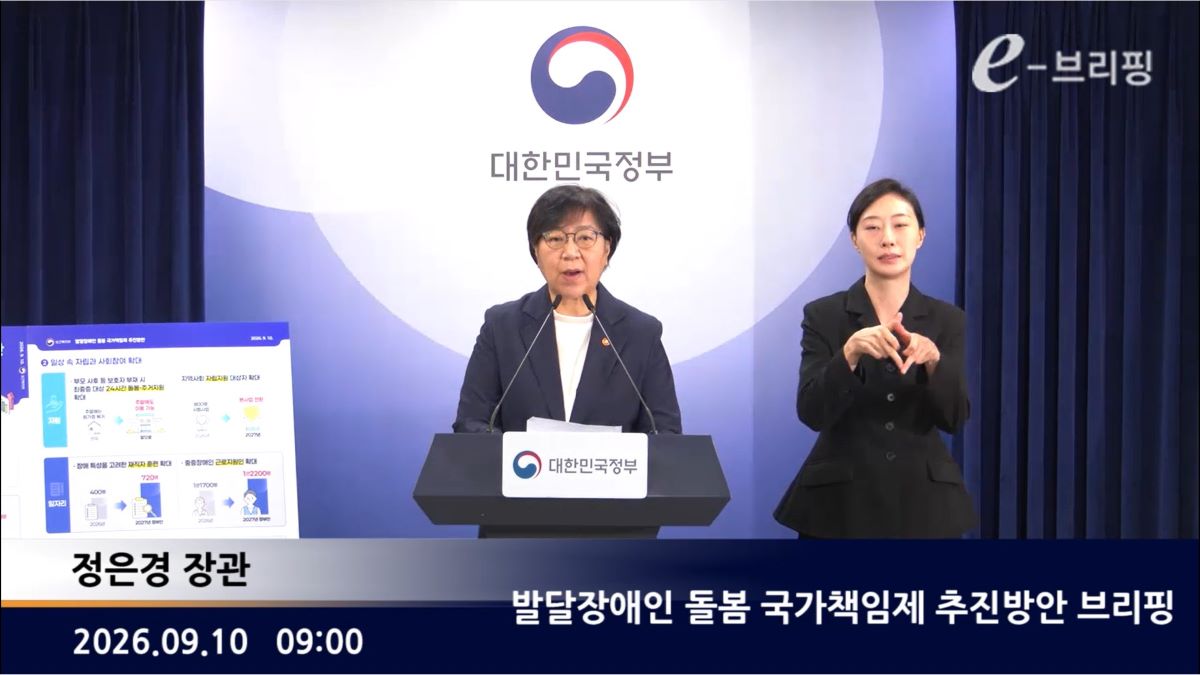
<이브리핑 화면 갈무리>
정부가 발달장애인과 그 가족이 지역사회에서 주체적인 삶을 살 수 있도록 돌봄부터 자립까지 공적 지원을 두텁게 보장하는 종합 대책을 내놓았다. 보건복지부는 관계부처 합동으로 9월 10일 「발달장애인 돌봄 국가책임제 추진방안」을 발표하고, 생애주기별 맞춤형 돌봄과 일상 속 자립 지원을 골자로 한 추진 과제들을 본격 시행하기로 했다.
이번 방안에 따르면 정부는 장애아동을 키우는 가정의 양육 지원 이용시간을 연 1,320시간까지 늘리고 장애아 전문·통합어린이집을 2,088개소로 확대한다. 발달재활서비스와 학령기 방과후활동 지원 대상을 함께 늘리는 한편, 성인 발달장애인의 낮 시간 활동을 돕는 주간활동서비스 대상도 단계적으로 확대하여 돌봄 대기 수요를 해소할 방침이다. 특히 야간 및 부모 부재 시에도 자립이 가능하도록 최중증 발달장애인 대상 24시간 1:1 개별 지원 서비스를 주말까지 확대 운영한다.
이와 함께 2027년 3월 「장애인지역사회자립법」 시행에 맞춰 주거·일자리·활동지원을 연계하는 자립지원사업을 전국으로 확산하고, 장애인 근로지원인 확대와 맞춤형 공공일자리 창출을 통해 경제적 자립도 돕는다. 아울러 16개 시·도에 ‘지역장애아동지원센터’를 신설하여 공적 지원 체계를 강화하고, 돌봄 종사자의 수당 신설 및 부모 휴식지원 대상 확대를 통해 현장 여건과 가족의 심리적 부담까지 종합적으로 개선할 계획이다.
우리나라 발달장애인은 약 28만 8천 명으로 전체 장애인의 11%를 차지하며, 인지와 의사소통의 어려움으로 높은 수준의 돌봄 지원이 절실한 실정이다. 정은경 보건복지부 장관은 “발달장애인도 보통의 일상을 누릴 권리가 있다”라며 “그동안 가족이 감당해 온 돌봄의 무게를 국가와 지역사회가 함께 나눌 수 있도록 지원체계를 지속해서 강화하겠다”라고 강조했다.
The government has unveiled a comprehensive plan to ensure robust public support from care to independence for individuals with developmental disabilities and their families to lead autonomous lives in the local community. The Ministry of Health and Welfare, in collaboration with relevant ministries, announced the "National Responsibility System for Care of Individuals with Developmental Disabilities" on September 10th, and decided to actively implement tasks focusing on tailored care throughout the life cycle and support for independence in daily life.
According to this plan, the government will extend the childcare support utilization time for families raising disabled children up to 1,320 hours per year and expand the number of specialized and integrated childcare centers for disabled children to 2,088. They will also gradually expand the target recipients for developmental rehabilitation services and after-school activities during school age, while also gradually expanding the target recipients for daytime activity services to help adults with developmental disabilities, aiming to alleviate the demand for care. Particularly, to enable independence even at night or in the absence of parents, individual support services for the most severe developmental disabilities will be expanded to operate until weekends.
In addition, in line with the implementation of the "Disability Community Independence Act" in March 2027, the government plans to expand independence support programs nationwide that link housing, employment, and activity support for people with disabilities, and support economic independence through the expansion of disability employment support and the creation of tailored public jobs. Furthermore, "Regional Disability Child Support Centers" will be established in 16 cities and provinces to strengthen the public support system, and plans to comprehensively improve on-site conditions and relieve family psychological burdens through the establishment of additional allowances for care workers and expanding support for parental rest.
In South Korea, individuals with developmental disabilities number approximately 288,000, accounting for 11% of all disabled individuals, and the urgent need for high-level care support due to difficulties in cognition and communication is evident. Minister of Health and Welfare Jeong Eun-kyung emphasized, "Individuals with developmental disabilities also have the right to enjoy ordinary daily life," stating, "We will continue to strengthen the support system to share the burden of care that families have been shouldering with the nation and local communities."