【전북장애인뉴스】전북 지역 장애인단체들이 시외고속버스 이용에서의 차별을 바로잡기 위해 법적 대응에 나섰다.
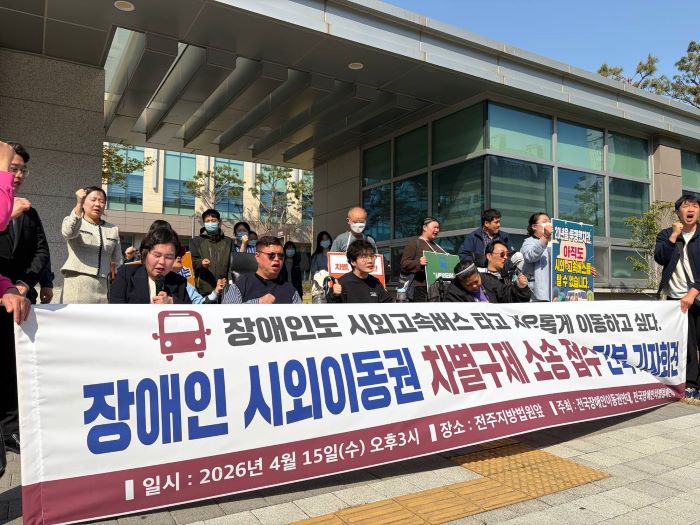
전국장애인이동권연대 전북지부와 장애인권단체들은 2026년 4월 15일 오후 3시 전주지방법원 앞에서 기자회견을 열고, 지역 내 대형 버스회사와 버스터미널 업체를 상대로 장애인 차별구제 소송을 제기했다고 밝혔다.
이들은 기자회견에서 비장애인의 경우 시외고속버스를 통해 자유롭게 도시 간 이동이 가능하지만, 휠체어 이용 장애인은 이를 이용할 수 없는 현실을 지적했다. 실제로 휠체어 탑승이 가능한 시외고속버스는 전국적으로 단 한 대도 운영되지 않았으며, 전북 지역 역시 상황은 동일했던 것으로 나타났다.
단체들은 “비장애인은 버스터미널만 방문하면 다른 지역으로 이동할 수 있지만, 장애인은 휠체어 탑승 설비가 없어 이동을 포기하거나 장애인 콜택시를 사전에 예약해야만 한다”고 주장했다. 이러한 구조는 장애인의 이동권을 심각하게 제한하는 차별이라고 강조했다.
또한 장애인 이동권 보장은 오랜 기간 요구되어 온 사안이었다. 장애인 단체들은 2014년 서울 고속버스터미널 투쟁을 시작으로 매년 명절마다 “장애인도 버스를 타고 이동하고 싶다”고 요구해 왔다고 설명했다.
그 결과 휠체어 탑승이 가능한 시외고속버스 모델이 개발되고 정부 차원의 예산도 편성됐지만, 버스회사들은 좌석 감소와 수익 악화를 이유로 해당 버스 도입을 기피해 온 것으로 알려졌다.
이에 전북지부는 버스회사들의 이러한 행태가 명백한 차별에 해당한다고 보고, 장애인차별금지법에 따른 적극적 구제 조치를 요구하는 소송을 제기했다고 밝혔다. 단체는 이번 소송을 통해 휠체어 이용 장애인도 시외고속버스를 이용할 수 있는 환경을 마련하겠다는 입장을 밝혔다.
한편, 앞서 2014년 서울에서 명성운수와 금호익스프레스를 상대로 제기된 소송과 2017년 광주에서 금호고속을 상대로 진행된 소송에서는 법원이 버스회사 측의 차별을 인정하고 개선을 명령한 바 있었다.
"Please Give Us a Ride!" Press Conference on Lawsuit for Redressing Discrimination in Interregional Mobility Rights in Jeonbuk Region
Disability organizations in the Jeonbuk region have taken legal action to correct discrimination in the use of intercity buses.
The Jeonbuk branch of the National Disability Movement Solidarity and disability rights organizations held a press conference in front of the Jeonju District Court at 3 p.m. on April 15, 2026, announcing that they have filed a lawsuit against major bus companies and bus terminal operators in the region for discrimination against people with disabilities.
During the press conference, they pointed out that while non-disabled individuals can freely travel between cities using intercity buses, wheelchair users with disabilities are unable to do so. In reality, there is not a single intercity bus nationwide that is equipped for wheelchair access, and the situation in Jeonbuk was found to be the same.
The organizations argued, "Non-disabled individuals can visit the bus terminal and travel to other regions, but people with disabilities have to give up on traveling or pre-book a disability-friendly taxi because there are no facilities for wheelchair users on buses." They emphasized that this structure severely limits the mobility rights of people with disabilities and constitutes discrimination.
Ensuring the mobility rights of people with disabilities has been a long-standing demand. The disability organizations explained that since the start of the Seoul Express Bus Terminal struggle in 2014, they have been demanding every holiday season that "people with disabilities also want to travel by bus."
As a result, wheelchair-accessible intercity bus models were developed, and government budgets were allocated, but bus companies have been avoiding introducing these buses citing seat reduction and profit decline as reasons.
In response, the Jeonbuk branch stated that they consider the actions of bus companies as clear discrimination and have filed a lawsuit demanding active remedial measures in accordance with the Anti-Discrimination Act for People with Disabilities. The organizations stated that through this lawsuit, they aim to create an environment where wheelchair users with disabilities can also use intercity buses.
Previously, in lawsuits filed in 2014 in Seoul against Myeongseong Transportation and Geumho Express, and in 2017 in Gwangju against Geumho Express, the courts recognized the discrimination by the bus companies and ordered improvements.
📝 Summary:
Disability organizations in the Jeonbuk region are taking legal action against major bus companies and terminal operators for discrimination against people with disabilities in the use of intercity buses. They argue that while non-disabled individuals can freely use these buses, those with disabilities face barriers due to lack of wheelchair accessibility.
🗣️ Natural Korean Translation:
전북 지역의 장애 단체들은 장애인들을 위한 시외버스 이용에서의 차별을 바로잡기 위해 법적 조치를 취하고 있습니다. 비장애인들은 자유롭게 시외버스를 이용할 수 있는 반면, 장애인들은 휠체어 접근성 부족으로 인해 장애를 겪고 있습니다.
❓ Comprehension Questions:
1. What legal action are disability organizations in the Jeonbuk region taking regarding intercity buses?
장애인 단체들이 시외버스에 대한 어떤 법적 조치를 취하고 있습니까?
2. Why are wheelchair users with disabilities facing barriers when using intercity buses according to the article?
기사에 따르면, 휠체어 이용자들이 시외버스를 이용할 때 어떤 장애물을 마주하고 있습니까?
3. What are the disability organizations aiming to achieve through the lawsuit against bus companies in Jeonbuk?
전북의 버스 회사에 대한 소송을 통해 장애인 단체들이 얻고자 하는 목표는 무엇입니까?
💡 Vocabulary Learning:
1. discrimination (차별, noun)
- Treating someone unfairly due to their differences.
- 다른 점 때문에 누군가를 부당하게 대우하는 것.
- The company was accused of discrimination against employees based on their gender.
- 그 회사는 직원들을 성별에 따라 차별했다는 비난을 받았다.
2. mobility (이동성, noun)
- The ability to move or travel freely.
- 자유롭게 움직이거나 여행할 수 있는 능력.
- Lack of public transport affects the mobility of residents in rural areas.
- 대중교통의 부족이 시골 지역 주민들의 이동성에 영향을 미친다.
3. remedial (보완적인, adjective)
- Intended to correct or improve something.
- 어떤 것을 바로잡거나 개선하기 위해 의도된.
- The teacher provided remedial lessons to help students catch up with the rest of the class.
- 선생님은 학생들이 나머지 학급과 따라잡을 수 있도록 보완적인 수업을 제공했다.
4. allocation (할당, noun)
- The action of distributing resources or duties for a particular purpose.
- 특정 목적을 위해 자원이나 임무를 분배하는 행동.
- The government announced the allocation of funds for new infrastructure projects.
- 정부는 새 인프라 프로젝트를 위한 자금 할당을 발표했다.
5. decline (감소, noun)
- A reduction or decrease in quantity or quality.
- 양이나 질의 축소나 감소.
- The decline in sales was attributed to changes in consumer preferences.
- 매출의 감소는 소비자 선호도의 변화로 인해 발생했다.

💬 댓글 (0)
댓글을 작성하려면 로그인이 필요합니다.
로그인첫 댓글을 작성해보세요!