【전북장애인뉴스】전북지역 장애인단체들이 장애인 이동권 보장을 위한 법 제정을 촉구하며 다시 거리로 나섰다.
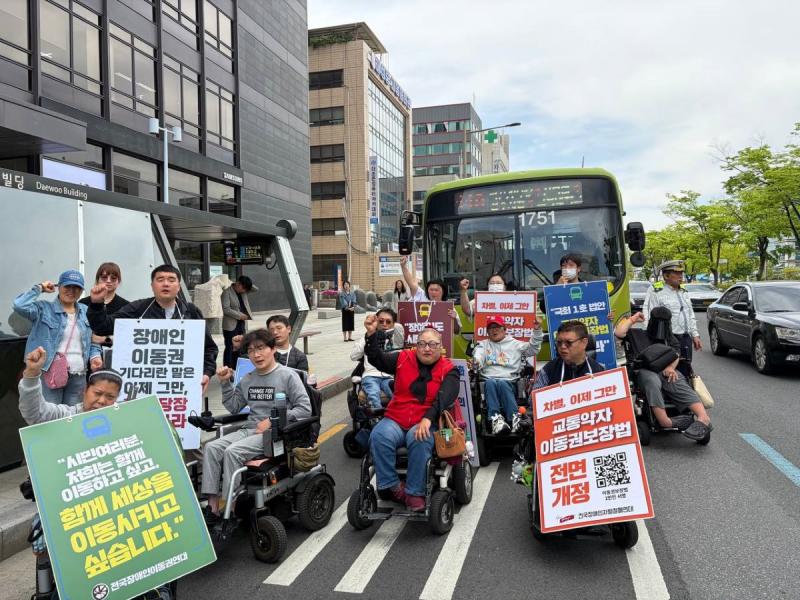
전북장애인차별철폐연대와 전국장애인이동권연대 전북지부는 지난 24일 오후 2시 전주시청 인근 대우빌딩 앞 버스정류장에서 ‘교통약자이동권보장법 제정을 위한 차별버스 OUT 전북행동(2차)’을 진행했다.
이들 단체는 장애인에 대한 구조적 차별을 해소하고 이동권을 보장하기 위해 전북 지역 장애인단체와 회원들이 모여 구성된 연대체로, 지속적인 행동을 통해 제도 개선을 요구하고 있다.
현재 국회에는 서미화 더불어민주당 의원이 대표 발의한 ‘교통약자법 전면개정안(교통약자이동권보장법)’이 계류 중이다. 해당 법안은 저상버스 도입 의무 확대와 장애인콜택시 등 특별교통수단 운영비에 대한 국비 지원을 포함하고 있으며, 장애인이 지역사회에서 동등한 시민으로 살아가기 위한 최소한의 제도적 기반을 담고 있다.
그러나 단체들은 국회 논의가 지연되고 있다는 점을 강하게 비판했다. 이들은 “지난 3월 27일 전북도청 앞에서 1차 ‘차별버스 OUT’ 행동을 진행하고 국토교통위원회 위원들에게 법 제정을 촉구하는 메시지를 전달했음에도, 현재까지 관련 논의가 진전되지 않고 있다”고 지적했다. 이어 “법 제정의 책임이 있는 상임위원회가 조속히 논의를 시작해야 한다”고 촉구했다.
전북지역의 열악한 교통 현실도 문제로 제기됐다. 2024년 교통약자 이동편의 실태조사에 따르면 전라북도의 저상버스 도입률은 31%로 전국 평균에도 미치지 못하는 수준이다. 특히 저상버스 도입이 면제되는 ‘예외노선’ 비율은 전국 평균 11%에 비해 전북은 31.6%로 세 배 가까이 높은 것으로 나타났다.
단체들은 “법적으로 예외노선에 대해 개선 계획을 제출하도록 되어 있음에도 별도의 예산 편성이나 실행 계획이 없어 실효성이 없다”며 “유예기간을 명시해 예외노선을 단계적으로 해소하고 저상버스 도입을 확대해야 한다”고 주장했다.
또한 “2008년 저상버스 확대를 위해 투쟁을 벌인 이후 20년 가까운 시간이 흘렀지만 상황은 크게 나아지지 않았다”며 “비장애인 중심의 차별적인 교통 현실을 더 이상 방치할 수 없다”고 강조했다.
이들은 “국회와 지자체의 무책임을 알리고, 이번 회기 내 전면 개정안이 통과될 때까지 ‘차별버스 OUT’ 행동을 멈추지 않을 것”이라며 지속적인 투쟁을 예고했다.
"Enact a Law Guaranteeing the Mobility Rights of Transportation-Disadvantaged Individuals Immediately"… Disability Rights Group in Jeonbuk Calls for 'No More Discriminatory Buses' in 2nd Action
Disability organizations in the Jeonbuk region have once again taken to the streets to urge the enactment of laws guaranteeing the mobility rights of people with disabilities.
The Jeonbuk Alliance for the Elimination of Disability Discrimination and the Jeonbuk branch of the National Alliance for the Mobility Rights of the Disabled held the 'Discriminatory Bus OUT Jeonbuk Action (2nd round)' near Daewoo Building, close to Jeonju City Hall, at 2 p.m. on the 24th.
These organizations, formed by disability groups and members in the Jeonbuk region to eliminate structural discrimination against people with disabilities and ensure mobility rights, are demanding institutional improvements through continuous actions.
Currently, a bill proposed by Rep. Seo Mi-hwa of the Democratic Party, the 'Comprehensive Amendment to the Transport Act (Transportation Rights Guarantee Act),' is pending in the National Assembly. The bill includes obligations to expand the introduction of low-floor buses and provide national support for special transportation means such as disability taxis, aiming to establish a minimum institutional basis for people with disabilities to live as equal citizens in the local community.
However, the organizations strongly criticized the delay in the parliamentary discussions. They pointed out that despite conducting the first 'Discriminatory Bus OUT' action on March 27 in front of the Jeonbuk Provincial Office and delivering a message urging the enactment of the law to the members of the Land, Infrastructure and Transport Committee, there has been no progress in the related discussions. They urged the standing committee responsible for the enactment of the law to promptly begin discussions.
The poor transportation reality in the Jeonbuk region was also raised as an issue. According to a survey on the convenience of transportation for people with disabilities in 2024, the low-floor bus introduction rate in Jeollabuk-do is 31%, which falls below the national average. Particularly, the rate of 'exception routes' exempt from low-floor bus introduction is significantly higher in Jeonbuk at 31.6% compared to the national average of 11%.
The organizations argued that despite the legal requirement to submit improvement plans for exception routes, the lack of separate budget allocation or implementation plans renders them ineffective. They insisted on specifying a grace period to gradually eliminate exception routes and expand the introduction of low-floor buses.
Furthermore, they emphasized that despite nearly 20 years passing since the struggle for the expansion of low-floor buses in 2008, the situation has not significantly improved. They stressed that the discriminatory transportation reality centered on non-disabled individuals cannot be ignored any longer.
They declared their intention to continue the struggle, stating that they will not stop the 'Discriminatory Bus OUT' actions until the comprehensive amendment is passed within this term, to raise awareness about the irresponsibility of the National Assembly and local governments.
📝 Brief Summary:
Disability organizations in the Jeonbuk region are advocating for laws to protect the mobility rights of people with disabilities. They are pushing for the introduction of low-floor buses and other support measures to ensure equal access to transportation.
🗣️ Natural Korean Translation:
전북 지역의 장애인 단체들은 장애인의 이동권을 보장하는 법률 제정을 촉구하고 있습니다. 저상 버스 도입 및 기타 지원 조치를 통해 교통 이용에 대한 평등한 접근을 보장하려고 노력하고 있습니다.
❓ Comprehension Questions:
1. What are the two organizations mentioned in the article and what are they advocating for?
장애인 차별 철폐를 위한 전북 연합과 장애인 이동권 국민연합 전북지부는 무엇을 촉구하고 있습니까?
2. What bill is currently pending in the National Assembly and what does it aim to achieve?
국회에 현재 상정된 법안은 무엇이며 무엇을 목표로 하고 있습니까?
3. What issue related to transportation was raised in the article and what are the organizations demanding regarding this issue?
기사에서는 교통에 관한 어떤 문제가 제기되었으며, 단체들은 이 문제에 관해 무엇을 요구하고 있습니까?
💡 Vocabulary Learning:
1. enactment (제정, noun)
- The enactment of laws is crucial for maintaining order in society.
- 사회 질서를 유지하기 위해서는 법률의 제정이 중요합니다.
2. institutional (제도적인, adjective)
- Institutional changes are necessary for progress in society.
- 사회적 진전을 위해 제도적 변화가 필요합니다.
3. discrimination (차별, noun)
- Discrimination based on disability is unacceptable.
- 장애에 기반한 차별은 용납할 수 없습니다.
4. structural (구조적인, adjective)
- Structural discrimination can be deeply ingrained in society.
- 구조적인 차별은 사회에 깊게 뿌리박혀 있을 수 있습니다.
5. implementation (실시, noun)
- Effective implementation of policies is essential for their success.
- 정책의 효과적인 실시는 그 성공에 필수적입니다.
**Note: The Korean translation of the example sentence should be placed directly below it without any labels.**

💬 댓글 (0)
댓글을 작성하려면 로그인이 필요합니다.
로그인첫 댓글을 작성해보세요!