The Labor Party and the Disability Rights Solidarity have embarked on joint action to guarantee the minimum wage for people with disabilities and to realize a living wage for care workers.
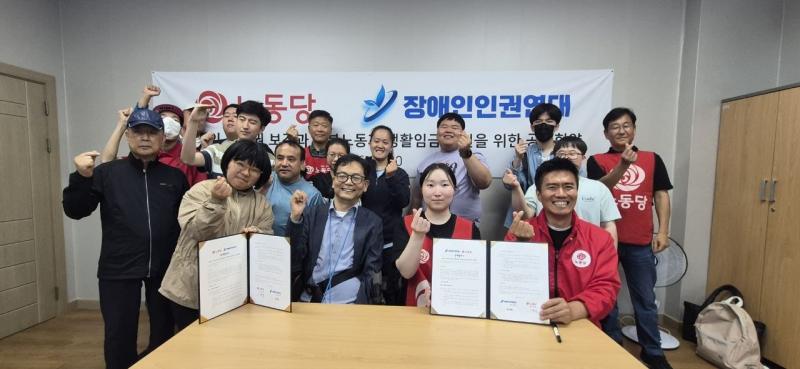
On the morning of the 20th, the Labor Party and the Disability Rights Solidarity signed a 'Joint Agreement for Guaranteeing the Labor Rights of People with Disabilities and Realizing a Living Wage for Care Workers' at the Disability Rights Solidarity office.
The signing ceremony was attended by Im So-hee, a proportional representative candidate of the Labor Party and a member of the Jeonju City Council, Lee Baek-yoon, the leader of the Labor Party, officials from the Jeonbuk Provincial Party of the Labor Party, as well as Chang-hyun Choi, the representative of the Disability Rights Solidarity, and its members.
The agreement was driven by the recognition that people with disabilities should be seen as equal citizens with the right to work and receive fair wages, rather than mere welfare recipients, and that care workers supporting the independent living of people with disabilities should be acknowledged as essential workers maintaining the local community.
Both parties stated in the agreement that "in reality, people with disabilities are working for wages below the minimum wage, and care workers are worried about their livelihoods in a low-pay and unstable employment structure," and they expressed their commitment to jointly pursue practical tasks to guarantee the labor rights of people with disabilities and the survival rights of care workers.
The main contents of the agreement are twofold.
First, ensuring the minimum wage for people with disabilities. The Labor Party and the Disability Rights Solidarity have agreed to push for the complete abolition of the exclusion clause for the minimum wage for people with disabilities under Article 7 of the Minimum Wage Act. They also agreed to jointly investigate the wage conditions of people with disabilities working in sheltered workshops, labor businesses, vocational rehabilitation facilities, and to conduct press conferences, policy document releases, and advocacy activities in local councils and the National Assembly based on the results.
Both parties emphasized that the costs necessary to maintain the employment of people with disabilities should not be passed on to the wages of people with disabilities. Instead, they advocated for stable employment of people with disabilities through support for labor costs from the national and local governments, expansion of employment incentives, and strengthening of job support.
Second, ensuring a living wage for care workers. Both parties agreed to push for system improvements to ensure that the actual hourly wage of care workers, including activity support workers, is guaranteed to be above the living wage along with an increase in the activity support fees for people with disabilities. They also agreed to prepare an ordinance revision including care workers such as activity support workers in the local government's living wage ordinance and to push for the introduction of career bonuses for long-serving care workers. Additionally, they planned to engage in joint activities to improve the working conditions of care workers, including guaranteeing rest breaks, compensating for travel time, and providing additional pay for night and holiday work.
Following the signing of the agreement, both parties presented immediate joint actions to be pursued, including a joint investigation into the wage conditions of people with disabilities and the working conditions of care workers, joint actions demanding the guarantee of the minimum wage for people with disabilities and the living wage for care workers, submission of a living wage ordinance revision proposal to local councils, and submission of a demand letter to the National Assembly and the government for the abolition of Article 7 of the Minimum Wage Act and an increase in activity support fees.
The Labor Party and the Disability Rights Solidarity stated through the joint declaration that "the labor rights of people with disabilities and the survival rights of care workers are indivisible rights," and that "people with disabilities should be able to receive fair wages and work, and care workers should also be able to work with dignity."
They further promised to "take joint action to guarantee the minimum wage for people with disabilities and realize a living wage for care workers."
📝 Brief Summary:
The Labor Party and the Disability Rights Solidarity have signed an agreement to ensure the minimum wage for people with disabilities and a living wage for care workers. They aim to support fair wages for people with disabilities and improve the working conditions of care workers.
🗣️ Natural Korean Translation:
노동당과 장애인권연대는 장애인의 최저임금 보장과 보호자의 생계임금 실현을 위한 합의서에 서명했습니다. 그들은 장애인에 대한 공정한 임금을 지원하고 보호자의 근로 환경을 개선하기 위해 노력하고 있습니다.
❓ Comprehension Questions:
1. What is the main goal of the agreement signed by the Labor Party and the Disability Rights Solidarity?
그 합의서에 의한 노동당과 장애인권연대의 주요 목표는 무엇입니까?
2. Who attended the signing ceremony of the agreement?
합의서 서명식에 누가 참석했나요?
3. What are the two main contents of the agreement between the Labor Party and the Disability Rights Solidarity?
노동당과 장애인권연대 간의 합의서의 주요 내용은 무엇입니까?
💡 Vocabulary Learning:
1. guarantee / 보장하다 (verb)
- To promise that something will definitely happen or is true
- 장애인의 최저임금을 보장하기 위해 노력하고 있습니다.
- They are working to guarantee the minimum wage for people with disabilities.
2. realization / 실현 (noun)
- The act of making something possible or achieving it
- 보호자의 생계임금을 실현하기 위해 노력하고 있습니다.
- They are making efforts to realize a living wage for care workers.
3. recognition / 인식 (noun)
- The act of accepting that something is true or important
- 장애인은 일하고 공정한 임금을 받을 권리가 있다는 인식을 가지고 있습니다.
- There is a recognition that people with disabilities have the right to work and receive fair wages.
4. essential / 필수적인 (adjective)
- Extremely important and necessary
- 장애인의 독립 생활을 지원하는 보호자는 지역 사회를 유지하는 필수적인 근로자로 인정되어야 합니다.
- Care workers supporting the independent living of people with disabilities should be acknowledged as essential workers maintaining the local community.
5. pursue / 추구하다 (verb)
- To try to achieve something over a period of time
- 그들은 장애인의 최저임금을 보장하고 보호자의 생계임금을 실현하기 위해 실질적인 과제를 추구할 것을 약속했습니다.
- They promised to pursue practical tasks to guarantee the labor rights of people with disabilities and the survival rights of care workers.

💬 댓글 (0)
댓글을 작성하려면 로그인이 필요합니다.
로그인첫 댓글을 작성해보세요!