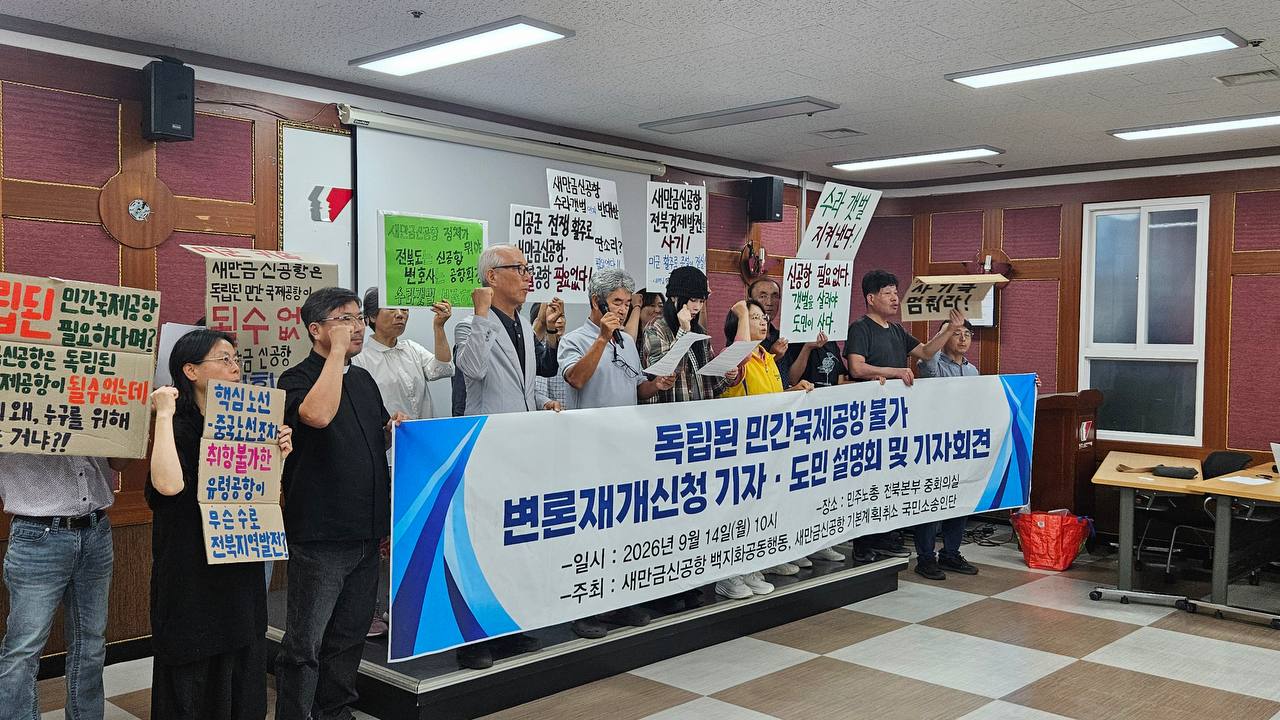
Joint Action to Blank Slate the New Airport in Saemangeum: "Independent Private Airport Impossible... Basic Plan Must Be Cancelled"
...
임창현 기자 (2026-09-15 05:54)
새만금 신공항 건설을 둘러싼 논란이 다시 확산되고 있다. 새만금신공항백지화공동행동과 새만금신공항 기본계획 취소 국민소송인단은 14일 기자회견을 열고 새만금 신공항이 당초 정부와 전북도가 내세운 ‘독립된 민간 국제공항’으로 운영되기 어렵다며 기본계획을 취소해야 한다고 주장했다.
이날 설명에 나선 김지은 공동집행위원장은 새만금 신공항과 군산공항 활주로가 약 1.35㎞ 떨어져 있어 관제공역 대부분이 중첩된다는 점을 핵심 문제로 제시했다.
공동행동 측은 “새만금 신공항과 군산공항의 공역이 약 90.8% 중첩된다”며 “독립된 공항으로 기능하려면 독자적인 공역과 관제 권한을 가져야 하지만 현재 입지에서는 통합관제가 불가피하다”고 주장했다. 국토교통부 기본계획에도 두 공항의 관할 공역이 대부분 중첩돼 통합관제시설을 설치·운영하는 내용이 담겨 있다는 것이 이들의 설명이다.
공동행동은 이러한 구조가 새만금 신공항 건설의 당초 명분과 충돌한다고 지적했다. 군산공항이 미군기지 안에 있어 국제선 운항 등에 제약이 있으므로 별도의 독립 민간 국제공항이 필요하다는 것이 새만금 신공항 추진의 주요 논리였지만, 새 공항 역시 군산공항과 관제체계를 공유할 경우 같은 문제가 반복될 수 있다는 주장이다.
특히 이들은 2017년 항공수요 조사 연구보고서 등에 현재 새만금 신공항 부지가 군산공항 관제권 내에 포함되고 미군과의 협의가 필요한 것으로 기술돼 있다고 주장했다. 또 보고서에 새만금 신공항이 사실상 “군산공항에 활주로가 추가되는 개념”이라는 취지의 내용도 포함돼 있다고 밝혔다.
현재 진행 중인 새만금 신공항 기본계획 취소소송 항소심에서 나왔다는 국토부 측 발언도 공개했다.
김 위원장은 “국토부 법률대리인이 항소심 법정에서 여러 차례 새만금 신공항을 ‘군산공항 확장’이라는 취지로 설명했다”고 주장했다. 이어 “과거 국토부와 전북도는 새만금 신공항이 군산공항 확장이라는 주장을 부정해 왔는데, 소송 과정에서는 오히려 군산공항 확장이라는 논리를 내세우고 있다”고 비판했다.
법률적 문제도 제기됐다. 공동행동은 공항시설법과 국토교통부 공역관리규정을 근거로 인접 공항의 비행절차와 관제구역이 중복돼서는 안 된다고 주장하면서, 새만금 신공항과 군산공항의 관제공역 중첩이 관련 규정에 어긋난다고 주장했다.
이들은 “새만금 신공항이 군산공항과 약 1.35㎞밖에 떨어져 있지 않아 공역이 90% 이상 중첩된다”며 “기본계획 수립과 전략환경영향평가 과정에서 이 문제에 대한 충분한 검토가 이뤄지지 않았다”고 주장했다.
경제성 문제도 다시 거론됐다. 공동행동은 국토부의 2019년 사업타당성 조사에서 비용편익비(B/C)가 0.37 수준으로 제시됐다며 새만금 신공항이 지역경제 활성화의 핵심 기반시설이라는 주장에도 의문을 제기했다.
이들은 항공수요와 물류 여건을 고려할 때 새만금 신공항이 국제 물류 허브나 글로벌 비즈니스 중심지로 성장할 가능성이 충분히 입증되지 않았다고 주장했다. 특히 국내 수출입 물류에서 항공화물이 차지하는 비중이 매우 낮고, 항공화물 역시 인천공항 등에 집중돼 있다는 점을 들어 공항 건설이 곧바로 투자 유치와 지역경제 활성화로 이어진다는 논리는 재검토해야 한다고 밝혔다.
환경 훼손과 군사적 이용 가능성도 문제 삼았다. 공동행동은 새만금 신공항 예정지와 주변 갯벌이 조류와 다양한 생물의 서식지라며 공항 건설로 돌이킬 수 없는 생태계 훼손이 발생할 수 있다고 주장했다. 또 군산 미군기지와 인접한 입지와 통합관제 구조 등을 근거로 새만금 신공항이 향후 미군의 군사적 활용과 연결될 가능성도 우려했다.
공동행동은 “새만금 신공항은 독립된 민간 국제공항으로 운영될 수 없으며 전북경제 활성화라는 사업 목적 역시 실현 가능성이 부족하다”며 “막대한 재정을 투입해 생태계를 훼손하면서 필요성이 충분히 입증되지 않은 공항을 건설해서는 안 된다”고 밝혔다.
이어 서울고등법원에 새만금 신공항 기본계획 취소소송의 변론재개를 신청했다며 “법원은 새롭게 제기된 관제권과 공역, 사업 목적의 문제를 다시 살펴 기본계획의 적법성을 판단해야 한다”고 촉구했다.
한편 공동행동이 이날 제기한 관제권 중첩과 관련 법령 위반 여부, 국토부 소송대리인의 법정 발언 취지 등은 향후 재판 과정에서 국토교통부 측의 반론과 법원의 판단을 통해 구체적으로 가려질 것으로 보인다.
Controversy surrounding the construction of the new airport in SaeManGeum is spreading once again. On the 14th, the SaeManGeum New Airport Blank Space Action Group and the National Lawsuit Group for the Cancellation of the SaeManGeum New Airport Basic Plan held a press conference, arguing that the basic plan should be canceled as it is difficult for the new airport to operate as the originally proposed "independent private international airport" by the government and Jeollabuk-do.
Kim Ji-eun, the co-executive director who explained on that day, pointed out that a key issue is that the runways of the SaeManGeum New Airport and Gunsan Airport are approximately 1.35 km apart, causing a significant overlap in control areas.
The Action Group stated, "Approximately 90.8% of the control areas of the SaeManGeum New Airport and Gunsan Airport overlap," and argued, "In order to function as an independent airport, it should have its own control area and authority, but at the current location, integrated control is inevitable." They explained that the basic plan of the Ministry of Land, Infrastructure and Transport also includes the installation and operation of integrated control facilities due to the significant overlap of the control areas of the two airports.
The group pointed out that this structure conflicts with the original justification for the construction of the SaeManGeum New Airport. While the main argument for promoting the SaeManGeum New Airport was the need for a separate independent private international airport due to restrictions on international flights at Gunsan Airport, if the new airport also shares control systems with Gunsan Airport, the same problem could arise.
In particular, they claimed that in the 2017 aviation demand survey report and others, the current site of the SaeManGeum New Airport is described as within the control jurisdiction of Gunsan Airport and requiring consultation with the US military. They also revealed that the report includes the concept that the SaeManGeum New Airport is essentially an "extension of Gunsan Airport."
They also criticized the Ministry of Land, Infrastructure and Transport for stating in the appellate court during the ongoing lawsuit to cancel the basic plan of the SaeManGeum New Airport that the new airport is an "expansion of Gunsan Airport." They argued that in the past, the Ministry of Land, Infrastructure and Transport and Jeollabuk-do had denied the claim that the SaeManGeum New Airport was an extension of Gunsan Airport, but in the lawsuit process, they are now emphasizing the logic of expanding Gunsan Airport.
Legal issues were also raised. The Action Group argued that based on the Airport Facilities Act and the Ministry of Land, Infrastructure and Transport's Control Area Management Regulations, the flight procedures and control areas of adjacent airports should not overlap, and the overlap of control areas between the SaeManGeum New Airport and Gunsan Airport violates related regulations.
They claimed, "The SaeManGeum New Airport is only about 1.35 km away from Gunsan Airport, with control areas overlapping by more than 90%," and argued, "There was insufficient consideration of this issue during the establishment of the basic plan and the process of strategic environmental impact assessment."
Economic issues were also brought up again. The Action Group raised doubts about the claim that the SaeManGeum New Airport is a core infrastructure for regional economic revitalization, as the Ministry of Land, Infrastructure and Transport's 2019 feasibility study presented a cost-benefit ratio (B/C) at the level of 0.37. They argued that the potential for the SaeManGeum New Airport to grow into an international logistics hub or a global business center has not been sufficiently proven when considering aviation demand and logistics conditions. They suggested that the logic that airport construction directly leads to investment attraction and regional economic revitalization should be reconsidered, given that the proportion of air cargo in domestic import and export logistics is very low and air cargo is concentrated at airports like Incheon.
Environmental damage and the possibility of military use were also raised as issues. The Action Group argued that the planned site of the SaeManGeum New Airport and the surrounding tidal flats are habitats for various birds and wildlife, and irreversible ecosystem damage could occur with airport construction. They also expressed concerns about the potential future military use of the SaeManGeum New Airport based on its location adjacent to the Gunsan US military base and the integrated control structure.
The Action Group stated, "The SaeManGeum New Airport cannot operate as an independent private international airport, and the business purpose of revitalizing Jeollabuk-do's economy is also lacking in feasibility," and emphasized, "Constructing an airport that has not been sufficiently proven necessary, while investing a huge amount of money and causing ecological damage, should not be done."
They further stated that they have applied for the resumption of arguments in the lawsuit to cancel the basic plan of the SaeManGeum New Airport at the Seoul High Court, urging the court to re-examine the legality of the basic plan by reviewing the newly raised issues of control jurisdiction, control areas, and the purpose of the project.
The issues raised by the Action Group on control area overlap, violation of related laws, the nature of the Ministry of Land, Infrastructure and Transport's legal representative's statements in court, etc., are expected to be clarified through the counterarguments of the Ministry of Land, Infrastructure and Transport and the court's judgment in the future trial process.