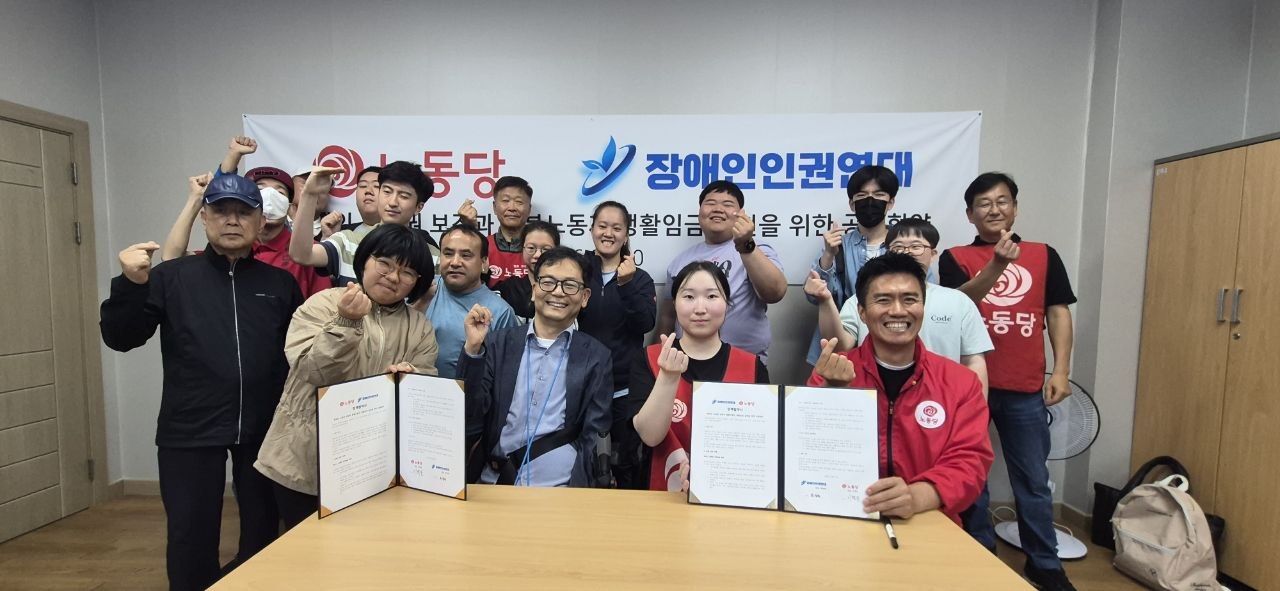
Labor Party and Disability Rights Alliance sign joint agreement to guarantee the labor rights of people with disabilities and achieve fair wages for care workers
이번 협약은 장애인을 복지의 대상이 아니라 노동할 권리와 정당한 임금을 받을 권리를 가진 동등한 시민으로 보고, 장애인의 자립생활을 지원하는 돌봄노동자를 지역사회를 유지하는 필수노동자로 인정해야 한다는 문제의식에서 추진됐다.
양측은 협약문에서 “현실에서는 장애인 노동자가 최저임금 이하의 임금을 받으며 일하고, 돌봄노동자는 낮은 수가와 불안정한 고용구조 속에서 생계를 걱정하고 있다”며 “장애인 노동권과 돌봄노동자의 생존권을 함께 보장하기 위한 실천 과제를 공동으로 추진하겠다”고 밝혔다.
협약의 주요 내용은 크게 두 가지다.
첫째, 장애인 최저임금 보장이다. 노동당과 장애인인권연대는 「최저임금법」 제7조에 따른 장애인 최저임금 적용 제외 조항의 완전 폐지를 추진하기로 했다. 또한 보호작업장, 근로사업장, 직업재활시설 등에서 일하는 장애인 노동자의 임금 실태를 공동 조사하고, 그 결과를 바탕으로 기자회견, 정책자료 발표, 지방의회·국회 건의 활동을 진행하기로 했다.
양측은 장애인 고용 유지에 필요한 비용을 장애인 노동자의 임금 삭감으로 전가해서는 안 된다고 강조했다. 대신 국가와 지방자치단체의 인건비 지원, 고용장려금 확대, 직무지원 강화 등을 통해 장애인 고용을 안정적으로 유지해야 한다는 입장이다.
둘째, 돌봄노동자 생활임금 보장이다. 양측은 장애인 활동지원 수가 인상과 함께 활동지원사 등 돌봄노동자의 실질 시급이 생활임금 이상으로 보장되도록 제도 개선을 추진하기로 했다.
또한 지방자치단체 생활임금 조례에 활동지원사 등 돌봄노동자를 포함하는 조례 개정안을 마련하고, 장기근속 돌봄노동자에 대한 경력수당 도입도 추진하기로 했다. 이와 함께 휴게권 보장, 이동시간 보상, 야간·휴일노동 가산수당 보장 등 돌봄노동자의 노동조건 개선을 위한 공동 활동도 벌일 계획이다.
협약 체결 이후 양측은 즉시 추진할 공동행동으로 △장애인 노동자 임금 실태와 돌봄노동자 처우 실태 공동조사 △장애인 최저임금 보장과 돌봄노동자 생활임금 보장을 요구하는 공동행동 △지방의회 생활임금 조례 개정안 제출 △국회와 정부에 「최저임금법」 제7조 폐지 및 활동지원 수가 인상 요구서 전달 등을 제시했다.
노동당과 장애인인권연대는 공동선언을 통해 “장애인의 노동권과 돌봄노동자의 생존권은 나눌 수 없는 권리”라며 “장애인이 정당한 임금을 받고 일할 수 있어야 하며, 돌봄노동자도 존엄하게 일할 수 있어야 한다”고 밝혔다.
이어 “장애인 최저임금 보장과 돌봄노동자 생활임금 실현을 위해 함께 행동할 것”이라고 약속했다.
The Labor Party and the Disability Rights Solidarity have embarked on joint action to guarantee the minimum wage for people with disabilities and to realize a living wage for care workers.
On the morning of the 20th, the Labor Party and the Disability Rights Solidarity signed a 'Joint Agreement for Guaranteeing the Labor Rights of People with Disabilities and Realizing a Living Wage for Care Workers' at the Disability Rights Solidarity office.
The signing ceremony was attended by Im So-hee, a proportional representative candidate of the Labor Party and a member of the Jeonju City Council, Lee Baek-yoon, the leader of the Labor Party, officials from the Jeonbuk Provincial Party of the Labor Party, as well as Chang-hyun Choi, the representative of the Disability Rights Solidarity, and its members.
The agreement was driven by the recognition that people with disabilities should be seen as equal citizens with the right to work and receive fair wages, rather than mere welfare recipients, and that care workers supporting the independent living of people with disabilities should be acknowledged as essential workers maintaining the local community.
Both parties stated in the agreement that "in reality, people with disabilities are working for wages below the minimum wage, and care workers are worried about their livelihoods in a low-pay and unstable employment structure," and they expressed their commitment to jointly pursue practical tasks to guarantee the labor rights of people with disabilities and the survival rights of care workers.
The main contents of the agreement are twofold.
First, ensuring the minimum wage for people with disabilities. The Labor Party and the Disability Rights Solidarity have agreed to push for the complete abolition of the exclusion clause for the minimum wage for people with disabilities under Article 7 of the Minimum Wage Act. They also agreed to jointly investigate the wage conditions of people with disabilities working in sheltered workshops, labor businesses, vocational rehabilitation facilities, and to conduct press conferences, policy document releases, and advocacy activities in local councils and the National Assembly based on the results.
Both parties emphasized that the costs necessary to maintain the employment of people with disabilities should not be passed on to the wages of people with disabilities. Instead, they advocated for stable employment of people with disabilities through support for labor costs from the national and local governments, expansion of employment incentives, and strengthening of job support.
Second, ensuring a living wage for care workers. Both parties agreed to push for system improvements to ensure that the actual hourly wage of care workers, including activity support workers, is guaranteed to be above the living wage along with an increase in the activity support fees for people with disabilities. They also agreed to prepare an ordinance revision including care workers such as activity support workers in the local government's living wage ordinance and to push for the introduction of career bonuses for long-serving care workers. Additionally, they planned to engage in joint activities to improve the working conditions of care workers, including guaranteeing rest breaks, compensating for travel time, and providing additional pay for night and holiday work.
Following the signing of the agreement, both parties presented immediate joint actions to be pursued, including a joint investigation into the wage conditions of people with disabilities and the working conditions of care workers, joint actions demanding the guarantee of the minimum wage for people with disabilities and the living wage for care workers, submission of a living wage ordinance revision proposal to local councils, and submission of a demand letter to the National Assembly and the government for the abolition of Article 7 of the Minimum Wage Act and an increase in activity support fees.
The Labor Party and the Disability Rights Solidarity stated through the joint declaration that "the labor rights of people with disabilities and the survival rights of care workers are indivisible rights," and that "people with disabilities should be able to receive fair wages and work, and care workers should also be able to work with dignity."
They further promised to "take joint action to guarantee the minimum wage for people with disabilities and realize a living wage for care workers."